
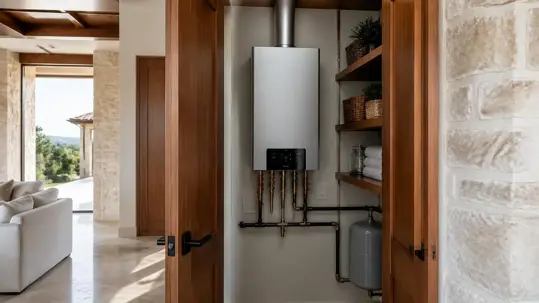
If your water heater is nearing the end of its life, you may be wondering whether to replace it with another traditional tank water heater or make the switch to a tankless model.
Neither water heater is automatically the right choice for every Texas home. A traditional tank water heater can make sense for homeowners who want a familiar system with a lower upfront cost, while a tankless water heater can be a strong option for homeowners who want continuous hot water, more usable space, and potentially lower energy use. The right choice depends on your household's hot water demand, available space, fuel source, budget, and the condition of your home's existing plumbing and electrical systems.
For homeowners in Austin, Lago Vista, Lakeway, Cedar Park, Leander, Bee Cave, and the surrounding Central Texas communities, there is another factor worth considering: hard water and mineral buildup can affect water heater performance and longevity.
Let's break down the differences so you can make an informed decision for your home.
Traditional vs. Tankless Water Heaters: At a Glance
| Feature | Traditional Tank | Tankless |
|---|---|---|
| Hot Water Supply | Limited by the tank's capacity | Heats water on demand |
| Upfront Cost | Generally lower | Generally higher |
| Space Required | Larger footprint | Compact, wall-mounted design |
| Hot Water Availability | Can run out during periods of high demand | Continuous while demand stays within the system's capacity |
| Standby Heat Loss | Yes | No tank standby heat loss |
| Potential Lifespan | Approximately 8 to 12 years | Often 15 to 20+ years with proper maintenance |
| Maintenance | Regular maintenance recommended | Regular flushing and maintenance recommended |
| May Be a Good Fit For | Homeowners looking for a familiar system and lower upfront cost | Homeowners wanting continuous hot water, space savings, and a long-term upgrade |
How Traditional Tank Water Heaters Work
A traditional water heater stores a supply of heated water inside a tank, commonly in sizes such as 40, 50, or 80 gallons.
When you turn on a hot water faucet, water leaves the tank and travels through your home's plumbing. Cold water then enters the tank and is heated for the next use.
This approach has been used in homes for decades because it is familiar, straightforward, and available in both gas and electric configurations.
Benefits of a Traditional Water Heater
Lower upfront investment: A traditional tank replacement is often less expensive than converting to a tankless system.
Simple replacement: If your existing home is already configured for a tank water heater, replacing it with another properly sized tank unit can be relatively straightforward.
Stored hot water: The tank keeps a supply of hot water ready when you need it.
Familiar technology: Homeowners, plumbers, and manufacturers have extensive experience with traditional water heaters.
For a homeowner who wants to replace an aging water heater without making major changes to the home, a traditional tank can be a practical solution.
The Drawbacks
The biggest limitation is capacity. Once the stored hot water is used, the system needs time to heat more water.
This can become noticeable in a busy household. Imagine a Saturday morning in a Lakeway or Bee Cave home with multiple showers, laundry running, and someone starting the dishwasher. Your water heater may suddenly feel like the busiest appliance in the house.
Traditional tanks also experience standby heat loss because they continually maintain the temperature of the stored water.
How Tankless Water Heaters Work
A tankless water heater takes a different approach.
Instead of keeping dozens of gallons of water hot inside a tank, a tankless system heats water as it flows through the unit. When a hot water fixture is turned on, the system activates and heats the incoming water.
This eliminates the standby losses associated with storing hot water in a tank. The U.S. Department of Energy notes that tankless systems can provide on-demand hot water and can have longer lifespans than conventional storage systems.
Benefits of a Tankless Water Heater
Continuous hot water: A properly sized tankless system can continue producing hot water as long as demand stays within its capacity.
Space savings: Tankless units are significantly more compact than traditional storage tanks.
Less standby energy loss: Because there is no large tank constantly maintaining water temperature, tankless systems avoid traditional tank standby losses.
Longer potential lifespan: Tankless systems can last considerably longer than traditional storage units when properly installed and maintained.
Great for high-demand households: If your family regularly runs out of hot water, a properly sized tankless system may provide a more convenient solution.
That does not mean tankless equals unlimited water under every circumstance. The system still has a maximum flow rate. If multiple showers, appliances, and faucets are demanding hot water simultaneously, proper sizing becomes extremely important.
Why Texas Homeowners Need to Think About Hard Water
Central Texas homeowners have another consideration that should not be overlooked: water quality.
Minerals and sediment can accumulate inside plumbing components and water heaters. Lantz specifically notes that hard water and mineral buildup can contribute to premature water heater problems in the Highland Lakes area.
For homeowners in Lago Vista, Jonestown, Leander, Cedar Park, Spicewood, Marble Falls, and other Highland Lakes communities, this makes water heater maintenance particularly important.
A water heater that is not properly maintained can become less efficient and experience premature component failure.
If your home has noticeable hard water, white mineral deposits around faucets, or recurring water quality concerns, it may also be worth looking into whole-home water filtration or other water treatment options.
Tankless vs. Traditional: Which Costs More?
This is where homeowners need to look beyond the installation price.
A traditional tank water heater generally has a lower initial purchase and installation cost. A tankless water heater typically requires a larger upfront investment, especially if your home needs modifications to accommodate the new system.
Depending on the existing setup, a tankless installation may involve changes to gas supply, venting, electrical requirements, water connections, or other components.
However, purchase price is only one part of the equation.
A tankless system may provide energy savings over time and can have a longer service life. The U.S. Department of Energy also notes that energy savings from tankless systems vary depending on household usage patterns.
That means the best question is not simply, "Which one is cheaper?"
Instead, ask:
Which water heater makes the most sense for how I use my home?
Which Water Heater Is Better for a Family?
Consider a traditional tank if:
- You want a lower upfront replacement cost.
- Your existing system is already configured for a tank.
- Your household's hot water demand is relatively predictable.
- You do not frequently run out of hot water.
- You prefer a familiar system.
Consider tankless if:
- Your household frequently runs out of hot water.
- You want continuous hot water within the system's flow capacity.
- You want to save space.
- You plan to stay in your home for many years.
- You are interested in reducing standby energy loss.
- You are willing to make a larger upfront investment for a long-term upgrade.
The most important step is proper sizing. A tankless water heater should be selected based on your home's maximum expected hot water demand and the required temperature rise, not simply the number of people living in the home.
What About Electric vs. Gas Water Heaters?
Fuel source matters too.
Traditional water heaters are commonly available in both gas and electric configurations. Tankless systems are also available in gas and electric models, but the home's existing infrastructure can influence which option makes sense.
For example, a high-demand electric tankless installation may have significant electrical requirements. A gas tankless installation may require appropriate gas supply and venting.
That is why water heater replacement is not always as simple as choosing a model online.
A professional plumber should evaluate the home's existing plumbing, electrical or gas connections, venting, available space, water demand, and installation requirements before recommending a system.
At Lantz Home Services, water heater installations include assessing hot water demand, properly sizing the unit, professional connections, required permitting, code-compliance checks, and a walkthrough after installation.
Don't Forget About the Rest of Your Home's Systems
A water heater does not operate in isolation.
Your home's plumbing, electrical, HVAC, and water treatment systems all work together to keep your household comfortable.
For example, if you are considering an electric water heater upgrade, your home's electrical capacity may need to be evaluated. If you are installing a gas water heater, the gas supply and venting need to be appropriate for the equipment.
And if your home is already experiencing water pressure problems, hard water, leaks, or aging plumbing, those issues may need attention before or during a water heater replacement.
That is one advantage of working with a company that handles plumbing, AC, heating, and electrical services under one roof. You can have the larger picture evaluated instead of treating every home system as a completely separate problem.
Related Lantz Home Services
Choosing a new water heater may uncover other opportunities to protect your home and improve efficiency.
Lantz Home Services provides residential plumbing, water heater repair and installation, sewer and drain services, water treatment, HVAC, air conditioning, heating, and electrical services throughout the Greater Austin and Central Texas area.
Related services homeowners may want to explore include:
- Water heater repair and replacement
- Tankless water heater installation
- Traditional water heater installation
- Water filtration and water treatment
- Plumbing repairs and repiping
- Drain cleaning
- Sewer and drain services
- Electrical services
- Air conditioning and HVAC maintenance
- Heating services
Whether your water heater is leaking, producing inconsistent hot water, or simply reaching the end of its expected service life, a licensed professional can help you compare repair and replacement options.
Protect Your Home With the Ultimate Home Care Plan
Your water heater is one of many systems working behind the scenes every day.
That is why preventative maintenance can be valuable for homeowners who would rather identify developing problems before they become emergencies.
The Ultimate Home Care Plan from Lantz Home Services is designed around ongoing care for major home systems, including plumbing, HVAC, and electrical inspections. Rather than waiting for a system to fail, homeowners can keep their home maintenance on a seasonal schedule and better understand the condition of their home's major equipment.
For busy Greater Austin homeowners, second-home owners around Lake Travis, and families who want fewer surprises, having a documented maintenance routine can make homeownership easier.
Learn more about the Ultimate Home Care Plan and how it can fit into your home's maintenance strategy.
Serving Lago Vista, Austin, and Surrounding Central Texas Communities
Water heater needs can look different from one neighborhood to another.
Lantz Home Services is based in Lago Vista and serves homeowners throughout the Greater Austin area, Lake Travis region, Highland Lakes, and Central Texas Hill Country.
Our service area includes communities such as:
- Lago Vista
- Austin
- Lakeway
- Bee Cave
- Cedar Park
- Leander
- Jonestown
- Point Venture
- Spicewood
- Marble Falls
- Horseshoe Bay
- Granite Shoals
- Burnet
- Sunrise Beach Village
Whether you own a primary residence, a lake house, or a second home, the right water heater should be selected around your property's actual needs.
Frequently Asked Questions About Tankless and Traditional Water Heaters
How long does a traditional water heater last?
A traditional tank water heater commonly lasts around 8 to 12 years, although actual lifespan varies based on equipment quality, installation, water quality, usage, and maintenance. Hard water and sediment buildup can contribute to premature problems.
How long does a tankless water heater last?
Tankless water heaters can have significantly longer service lives than traditional storage units. DOE research indicates gas-fired instantaneous water heaters can have estimated average lifetimes around 20 years, although actual lifespan depends on maintenance, water quality, usage, and installation.
Do tankless water heaters really provide unlimited hot water?
Tankless systems can provide continuous hot water, but they still have a maximum flow rate. Proper sizing is essential if multiple showers, faucets, and appliances may operate at the same time.
Is a tankless water heater more energy efficient?
Tankless systems eliminate the standby heat losses associated with storing hot water in a traditional tank. However, actual energy savings depend on the equipment and how your household uses hot water.
Is a tankless water heater worth it in Texas?
It can be, particularly for homeowners who want continuous hot water, additional space, and a potentially longer-lasting system. The higher upfront installation cost means the decision should be based on your household's needs and long-term plans.
Does hard water affect tankless water heaters?
Yes. Mineral buildup can affect water heaters and plumbing components. Regular maintenance and appropriate water treatment can help protect equipment, particularly in areas with hard water.
Should I repair or replace my water heater?
Age, condition, repair history, performance, efficiency, and replacement cost all matter. A professional inspection can help determine whether repairing the existing system makes sense or whether replacement is the better long-term solution.
The Right Water Heater Is the One That Fits Your Home
There is no universal winner in the tankless vs. traditional water heater debate.
A traditional tank water heater may provide the straightforward replacement and lower upfront investment you are looking for. A tankless water heater may make more sense if you want continuous hot water, space savings, and a longer-term upgrade.
The key is choosing a properly sized system and having it installed correctly.
If you are replacing a water heater in Austin, Lago Vista, Lakeway, Cedar Park, Leander, Bee Cave, or the surrounding Central Texas area, Lantz Home Services can help you understand your options and choose a solution based on your home's needs.
When it comes to your home's hot water, you do not have to guess. Leave it to Lantz.