
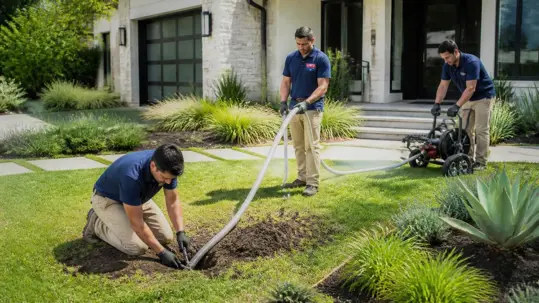
If your sewer line is damaged, you do not necessarily have to dig up your entire yard to fix it. Trenchless sewer repair can restore or replace certain sewer lines with significantly less excavation than traditional open-trench repair. However, trenchless is not automatically the best option for every home. The right repair depends on the condition, location, material, alignment, and accessibility of your sewer line.
For homeowners in Lago Vista, Austin, Georgetown, Leander, Cedar Park, Lakeway, and throughout Central Texas, understanding the difference between trenchless and traditional sewer repair can help you make a confident decision when a sewer problem occurs.
At Lantz Home Services, we believe homeowners deserve to understand what is wrong, why it happened, and what their options are before deciding how to repair it. With more than 50 years serving Central Texas, our team has experience with the plumbing and sewer challenges that come with Hill Country homes, lake properties, mature landscaping, and changing soil conditions.
What Is Trenchless Sewer Repair?
Trenchless sewer repair is a method of repairing or replacing underground sewer piping without excavating a continuous trench along the entire length of the pipe.
Depending on the condition of the existing sewer line, trenchless work may involve pipe lining or pipe bursting.
Pipe Lining
Cured-in-place pipe, commonly called CIPP, creates a new pipe inside the existing sewer line. A flexible liner coated with resin is inserted into the damaged pipe and cured in place, forming a durable, seamless interior.
Pipe lining is generally best suited for sewer pipes that are damaged but still structurally suitable for the process. A camera inspection is an important part of determining whether the existing pipe is a candidate.
Pipe Bursting
Pipe bursting takes a different approach. A specialized bursting head breaks apart the old pipe while a new pipe is pulled into place along the existing path. This can provide a new sewer line without excavating the entire run.
Pipe bursting can be useful when the existing pipe needs full replacement but the property would benefit from avoiding a long open trench. Industry guidance recognizes pipe bursting as a trenchless replacement technology that can replace a lateral in the same or larger diameter without excavating the entire line.
What Is Traditional Sewer Repair?
Traditional sewer repair, also called open-trench or open-cut sewer repair, involves excavating the ground to expose the damaged pipe.
Once the pipe is accessible, the damaged section can be repaired or the sewer line can be removed and replaced. The excavation is then backfilled and the surface restored.
Traditional sewer replacement remains an important option because trenchless methods have limitations. Severe pipe collapse, significant alignment problems, difficult access, certain pipe configurations, or other site conditions can make excavation the more practical solution.
The goal should never be to choose the method that sounds most modern. The goal is to choose the method that provides the right long-term solution for your particular sewer line.
Trenchless vs. Traditional Sewer Repair
Trenchless Sewer Repair Benefits
For the right property, trenchless sewer repair can offer several advantages:
Less disruption to your property: Because there is no continuous trench running across the yard, trenchless methods can reduce disturbance to lawns, landscaping, driveways, sidewalks, and other improvements.
Potentially faster restoration: Less excavation can mean less time spent restoring the property after the sewer work is complete.
Long-term rehabilitation: Properly designed and installed trenchless systems can provide a durable solution. NASSCO notes that properly designed, installed, and tested CIPP lateral renewals can have a minimum life expectancy of 50 years.
Useful for difficult-to-access areas: Trenchless techniques can be particularly valuable when a sewer line runs underneath landscaping, hardscaping, or other areas where excavation would create significant disruption.
That can matter quite a bit around Central Texas homes. A mature oak tree, established garden, driveway, or expensive landscaping can make a traditional excavation much more complicated.
Limitations of Trenchless Repair
Trenchless does not mean completely without digging, and it does not work for every sewer problem.
Pipe bursting generally requires access points, and surrounding utilities, structures, soil conditions, and the sewer's location all need to be considered.
Pipe lining also requires the existing pipe to be suitable for the liner. A severely collapsed or badly distorted pipe may not provide the necessary pathway for installation. A significant belly or improper grade can also require excavation because lining does not correct the underlying slope of the sewer.
That is why a sewer camera inspection is so valuable. Rather than guessing, your plumber can see what is happening inside the line and evaluate the condition before recommending a repair method.
Traditional Sewer Repair Benefits
Traditional excavation has one major advantage: direct access to the pipe.
When the sewer line is severely damaged, collapsed, badly offset, incorrectly graded, or otherwise unsuitable for trenchless technology, excavation may provide the most dependable way to correct the underlying problem.
It can also make sense when only a small, localized section needs to be repaired and that section is easy to access.
Traditional repair can be more disruptive because the ground must be opened, but sometimes the most straightforward solution is also the best long-term solution.
Which Sewer Repair Method Is Better?
There is no universal winner.
The best sewer repair method depends on your home's sewer line, not a sales pitch.
A professional evaluation should consider:
- The age and material of the existing sewer pipe
- The location and depth of the line
- Cracks, breaks, roots, or corrosion
- Whether the pipe has collapsed
- Pipe alignment and slope
- Existing cleanouts and access points
- Nearby utilities and structures
- Landscaping, driveways, patios, or other improvements
- The length of the damaged section
- Your property's future needs
This is one reason Lantz Home Services emphasizes diagnosis before recommending repairs. Our approach is to identify the actual problem, explain your options clearly, and provide honest recommendations without rushing you into a decision.
Why Sewer Camera Inspections Matter
A sewer backup is frustrating enough without having to guess what caused it.
A sewer camera inspection allows a trained professional to examine the inside of the line and identify issues such as root intrusion, cracks, breaks, buildup, offsets, or other damage. The information from that inspection can help determine whether the line should be cleaned, repaired, lined, replaced, or monitored.
For Central Texas homeowners, this type of diagnosis is especially helpful because homes can have very different plumbing configurations depending on their age, location, and connection to local utilities.
If you live in a lake community, for example, your home may have a grinder pump or other equipment that requires a different approach than a typical subdivision property. Lantz specifically serves homes throughout the Highland Lakes and understands the plumbing and wastewater systems common to the area.
What About Cost?
The cost of sewer repair depends heavily on the specific property and repair method.
Traditional excavation can involve additional costs for digging, hauling, backfilling, and restoring landscaping or hardscaping. Trenchless repair can reduce those restoration requirements, but the technology, equipment, access requirements, and condition of the existing pipe can affect the price. If you are unsure whether your property is even on a sewer line, start with septic or sewer: how to tell what your home has.
That means the cheapest-looking option on paper is not always the least expensive long-term solution.
A professional should evaluate the sewer line and explain what you are paying for, why the recommended method fits your home, and what alternatives are available.
At Lantz Home Services, we provide upfront pricing and clear options so homeowners can make informed decisions about their plumbing and sewer repairs. Financing is available for larger sewer replacements.
Related Lantz Home Services
Sewer problems rarely exist in isolation. Our team provides more than sewer repair, with plumbing, electrical, heating, air conditioning, water treatment, indoor air quality, and other residential home services under one roof.
Our plumbing and sewer services include drain cleaning, rooter service, sewer diagnostics, sewer repairs, grinder pump services, and other plumbing solutions. Having multiple trades in one company also means we can help homeowners identify when a plumbing issue may involve another part of the home.
Whether you need a sewer camera inspection, drain cleaning, water heater service, AC maintenance, or electrical repair, our licensed and experienced team is here to help Central Texas homeowners keep their homes running properly.
Prevent Sewer Problems With the Ultimate Home Care Plan
For homeowners who prefer preventative maintenance over unexpected emergencies, the Ultimate Home Care Plan provides a proactive approach to maintaining your home's major systems.
The plan includes seasonal inspections for plumbing, HVAC, and electrical systems, helping identify potential problems before they become larger repairs. Preventative maintenance can be particularly valuable for second homes, lake properties, and homeowners who would rather address a developing issue during a scheduled visit than discover it during a weekend backup.
A maintenance plan cannot prevent every sewer problem, but regular attention to your home's plumbing systems can help you stay ahead of developing issues and understand the condition of important equipment.
Serving Central Texas for Over 50 Years.
Lantz Home Services has been serving Austin and the Texas Hill Country since 1972. Today, our team serves homeowners throughout Lago Vista, Austin, Georgetown, Leander, Cedar Park, Lakeway, Bee Cave, Spicewood, Round Rock, and surrounding Central Texas communities.
Our Lago Vista location is especially familiar with the unique plumbing needs of Highland Lakes homeowners, including grinder pumps, lake-area properties, hard water, wells, and other systems that can require specialized knowledge.
Whether you are in a newer Georgetown neighborhood, an established Austin home, or a lakefront property in Lago Vista, the right sewer repair starts with understanding what is actually happening underground.
Frequently Asked Questions About Trenchless Sewer Repair
Is trenchless sewer repair better than traditional sewer repair?
Not necessarily. Trenchless repair can reduce excavation and property disruption, but it is only appropriate for certain sewer conditions. A camera inspection and professional evaluation should determine which method is best.
Does trenchless sewer repair mean no digging?
Not always. Some trenchless methods require small access points or excavation at specific locations. However, they can avoid the continuous trench associated with traditional sewer replacement.
How long does trenchless sewer repair last?
The lifespan depends on the technology, materials, installation quality, existing pipe condition, and site conditions. NASSCO states that properly designed, installed, and tested CIPP lateral renewals can have a minimum life expectancy of 50 years.
Can trenchless repair fix a collapsed sewer line?
It depends on the severity and location of the collapse. A completely collapsed section may prevent a liner from being installed and can require excavation or another repair approach.
Does pipe lining replace my old sewer pipe?
Pipe lining creates a new pipe inside the existing pipe. The original pipe remains underground and serves as the host for the liner.
When is traditional sewer replacement the better option?
Traditional excavation may be preferable when the pipe is severely collapsed, badly misaligned, has significant grade problems, or cannot accommodate a trenchless method. Site access and surrounding utilities can also influence the decision.
How do I know which sewer repair option I need?
Start with an accurate diagnosis. A sewer camera inspection can provide valuable information about the pipe's condition, location, and potential repair options. From there, a qualified plumbing professional can explain whether cleaning, spot repair, trenchless rehabilitation, pipe bursting, or traditional replacement makes the most sense.
Ready to Find Out What Is Happening in Your Sewer Line?
If you are dealing with recurring backups, slow drains, sewer odors, or other signs of a sewer problem, do not wait for a small warning to become a major mess. Lantz Home Services has served Central Texas homeowners for more than 50 years, combining local knowledge with licensed plumbing expertise and honest recommendations.
Whether trenchless sewer repair or traditional excavation is right for your home, the first step is understanding the problem. Leave it to Lantz.
Bottom of Form